History of CNC Technology

The history of CNC (Computer Numerical Control) technology dates back to the mid-20th century. In the late 1940s and early 1950s, researchers and engineers began exploring ways to automate machine tool operations using electronic controls. Early efforts involved analog computers and punch-card systems to control machine movements.

The breakthrough came in the late 1950s when John T. Parsons and his team at the Massachusetts Institute of Technology (MIT) developed the concept of numerical control (see the patent). They combined digital computers with existing machine tools, effectively creating the foundation for CNC technology. The first CNC machine, a Cincinnati Hydrotel milling machine retrofitted with a computer control system, was introduced in the early 1960s.

As computing technology advanced, CNC systems evolved from punch-card readers to more sophisticated computer interfaces. The 1970s saw the adoption of microprocessors, which improved the processing speed and capabilities of CNC machines. This led to increased precision, complexity, and versatility in machining operations.
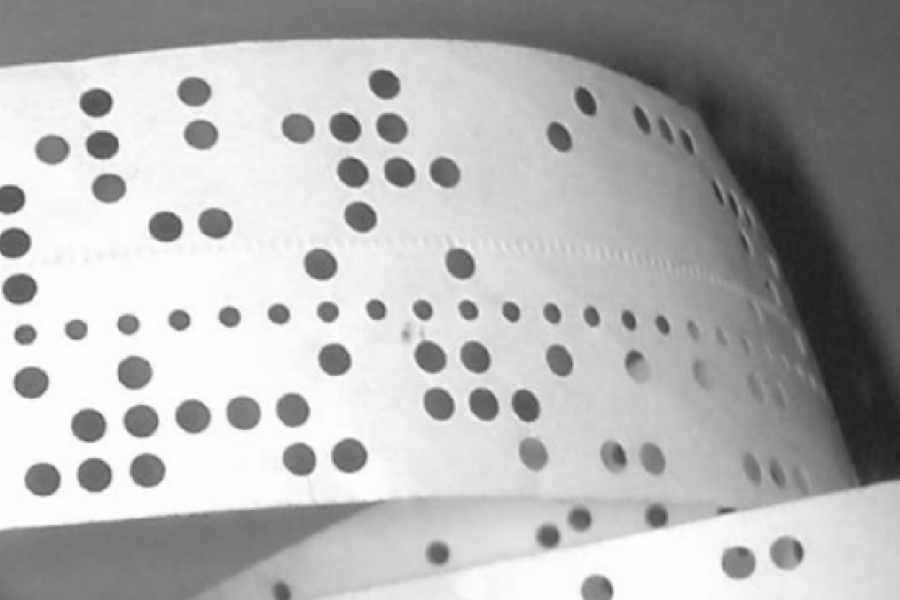
The 1980s marked a significant turning point with the integration of CAD (Computer-Aided Design) and CAM (Computer-Aided Manufacturing) software with CNC systems. This merger enabled seamless design-to-production workflows and paved the way for 3D machining.

Since then, CNC technology has continued to advance, incorporating features like multi-axis control, adaptive machining, and high-speed machining. CNC machines are now capable of producing intricate and precise components across various industries with minimal human intervention.

Today, CNC technology is an integral part of modern manufacturing, contributing to efficiency, accuracy, and automation. It has shaped the way products are designed, developed, and produced, revolutionizing industries ranging from aerospace and automotive to electronics and medical devices.

Scientific American
Vol. 187, No. 3, September 1952
An Automatic Machine Tool

References

Pease, William. “An Automatic Machine Tool.” Scientific American, vol. 187, no. 3, 1952, pp. 101–115, www.jstor.org/stable/24950784?seq=1#metadata_info_tab_contents. Accessed 30 Aug. 2023.
The Jacquard Loom

The Jacquard Loom
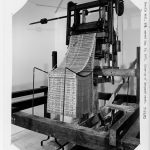
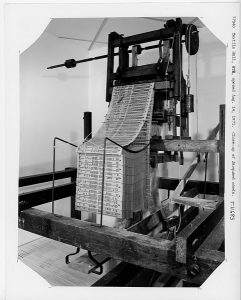
Joseph Marie Jacquard is rarely mentioned in machining textbooks, yet the loom that bears his name represents one of the most important conceptual shifts in the history of manufacturing. Long before numerical control, long before electronics, and even before modern machine tools, the Jacquard loom demonstrated that a machine could execute complex, repeatable operations by...

Tracer Lathe & Mills

Tracer Lathe & Mills
These machines were used historically in machining and manufacturing before the widespread adoption of CNC (Computer Numerical Control) technology. Tracer lathes and mills are manually operated machines that use mechanical or hydraulic systems to follow a template or master model. The tracer mechanism duplicates the shape and movements of the template onto the workpiece, allowing...

Screw Machines

Screw Machines
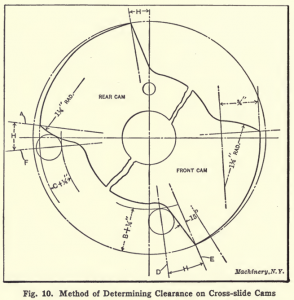
Screw machines are specialized lathes designed to manufacture parts from bar stock through a fixed sequence of operations. Unlike engine lathes, where an operator manually controls tool motion, screw machines automate tool movement using a system of cams, linkages, and mechanical timing mechanisms. Once set up, the machine repeatedly performs the same cycle with minimal...

The Parsons–MIT–Air Force Project: The Birth of Numerical Control

By the mid-twentieth century, manufacturing had reached a point of remarkable mechanical sophistication. Tracer machines could reproduce complex geometry, and automatic screw machines could execute intricate sequences with extraordinary speed. Yet both approaches shared a fundamental limitation: control was embedded physically in templates, cams, and linkages. As aerospace designs grew more complex during and after...

Adoption of NC Technology

When numerical control first emerged in the early 1950s, it was not immediately embraced by the broader manufacturing industry. Early NC machines were expensive, complex, and heavily dependent on specialized knowledge. Programming required extensive manual calculation, punched tape preparation was time-consuming, and maintenance demanded expertise in servomechanisms and electronics that few shops possessed. Yet within...
The Jacquard Loom

The Jacquard Loom

Joseph Marie Jacquard is rarely mentioned in machining textbooks, yet the loom that bears his name represents...
Tracer Lathe & Mills

Tracer Lathe & Mills

These machines were used historically in machining and manufacturing before the widespread adoption...
Screw Machines

Screw Machines

Screw machines are specialized lathes designed to manufacture parts from bar stock through a fixed sequence...

The Parsons–MIT–Air Force Project: The Birth of Numerical Control

By the mid-twentieth century, manufacturing had reached a point of remarkable mechanical sophistication....

Adoption of NC Technology

When numerical control first emerged in the early 1950s, it was not immediately embraced by the broader...