Fundamental Quantities

A fundamental (or base) quantity in physics is a basic and essential physical property or dimension that cannot be defined in terms of other physical properties. These quantities are the building blocks upon which the entire system of measurement and units is constructed. They represent the most elementary aspects of the physical world and are typically independent of one another. In the International System of Units (SI), there are seven fundamental quantities: length, mass, time, electric current, temperature, amount of substance, and luminous intensity. These fundamental quantities provide a framework for describing and measuring various physical phenomena and are the starting point for deriving all other physical units.
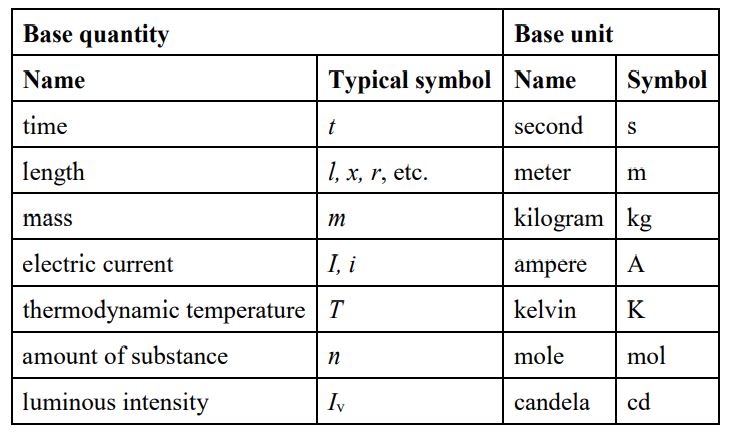
SI Base Quantities and Base Units (NIST https://nvlpubs.nist.gov/nistpubs/SpecialPublications/NIST.SP.330-2019.pdf)

Mass

Mass
In engineering and physics, mass is a fundamental property of matter that quantifies the amount of substance in an object. Unlike weight, which depends on gravitational force, mass is an intrinsic property and remains constant regardless of location. It directly influences an object's resistance to acceleration when a force is applied, as described by Newton’s...

Length

Length
Length is considered a fundamental quantity because it describes one of the most basic and irreducible aspects of the physical world: the extent of space in one dimension. When we say something has length, we are specifying how far it stretches from one point to another. This idea does not depend on any other physical...
Mass

Mass

In engineering and physics, mass is a fundamental property of matter that quantifies the amount of...
Length

Length

Length is considered a fundamental quantity because it describes one of the most basic and irreducible...
History of the Meter

History of the Meter

The idea of the meter emerged during the late 18th century, at a time when France was undergoing the...