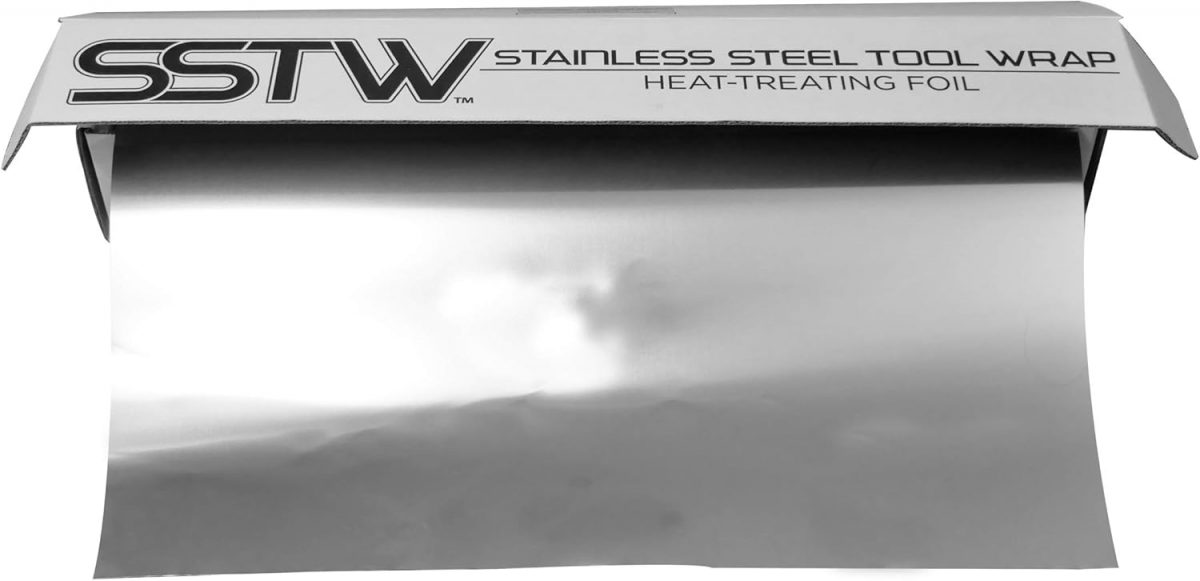
Stainless steel heat-treating foil and foil bags are used to protect steel parts from oxidation and decarburization during furnace heating. The bags are typically made from thin heat-resistant stainless foil and are sealed around the workpiece before being placed into the furnace. By limiting the amount of oxygen that can reach the hot metal surface, the bags help reduce scale formation and preserve surface carbon content during heat treatment.
These bags are commonly used for tool steels, knife blades, springs, and precision-machined components where surface finish and dimensional accuracy are important. In many applications, the parts are wrapped in stainless tool-wrap foil and folded tightly to create a nearly airtight enclosure. Small strips of paper are sometimes placed inside the bag before sealing. During heating, the paper consumes some of the residual oxygen inside the enclosure as it burns, helping create a more reducing atmosphere.
In some industrial applications, inert gases such as argon or nitrogen may also be introduced into the bag or enclosure to further displace oxygen. Argon is particularly useful because it is chemically inert and does not react with the heated steel. Gas purging is more common in specialized or higher-value heat treatment operations where additional atmospheric control is desired. However, for many shop applications, careful sealing of the stainless foil alone provides substantial protection against scaling.
Although stainless foil bags are highly effective, they are not perfect substitutes for vacuum furnaces or fully controlled-atmosphere heat treatment systems. Small leaks, poor seals, or damage to the foil can still allow oxidation to occur. Even so, foil wrapping remains a widely used and economical method for improving heat-treatment surface quality in both commercial and small-scale operations.