
A combination square is a modular measuring and layout tool built around a graduated rule and one or more interchangeable heads. It is commonly used in both metalworking and woodworking for inspection, marking, and basic measurement tasks. The defining characteristic is that the heads slide along the rule and can be locked in position, allowing the tool to function as a square, depth gauge, height gauge, and marking guide.
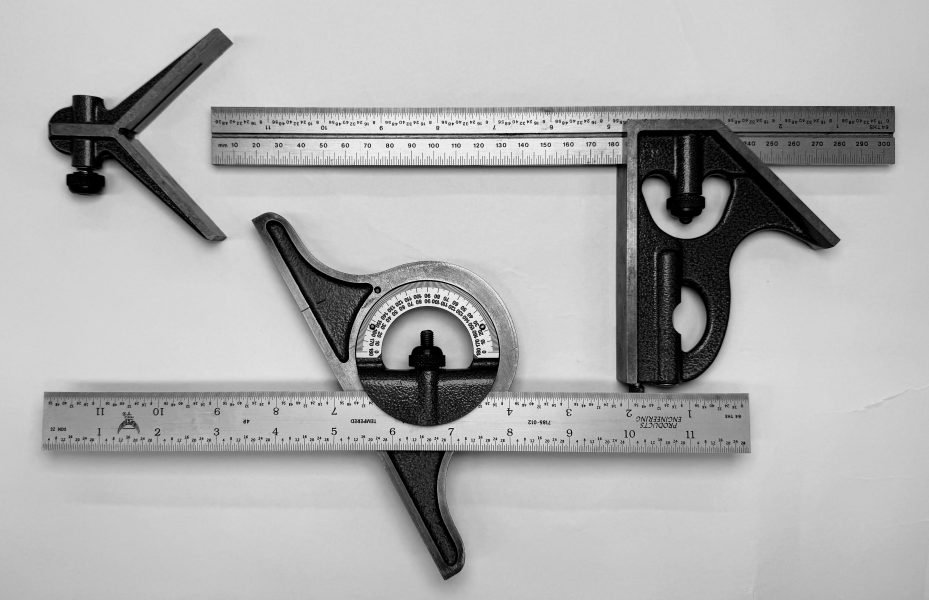
The rule is typically steel and graduated in inches (often to 1/16, 1/32, or finer) and sometimes metric. Because the rule serves as the reference surface for all configurations, its straightness and edge condition directly affect accuracy. The heads attach to the rule using a slot and clamp mechanism, which should provide firm, repeatable positioning without play.
The most common head is the square head. This head provides two primary reference faces: one at 90 degrees and one at 45 degrees relative to the rule. In practice, this allows the tool to check perpendicularity and common miter angles, as well as to transfer those angles to a workpiece. Many square heads include a small spirit level and a removable scriber stored in the body. The level is useful for rough alignment tasks, though it is not a substitute for a dedicated precision level.
A protractor head can be substituted when adjustable angles are required. This head includes a graduated scale, allowing the user to set and transfer angles over a wide range. While useful for layout, the accuracy depends on the resolution of the scale and the care taken in reading and locking the setting. For higher-precision angular measurement, dedicated instruments are typically preferred.
A center head is used to locate the center of cylindrical or round stock. It forms a 90-degree “V” that aligns with the outside diameter of the part. When a line is scribed along the rule, it passes through the center of the cylinder. Repeating the operation at a different orientation confirms the location by intersection. This is a common method for preparing parts for turning or drilling operations.
In use, the combination square often functions as a marking guide. The head is set to a desired distance along the rule, locked, and then run along the edge of a workpiece while a scribe or pencil marks a parallel line. This technique depends on consistent contact between the head and the reference edge; debris or burrs will introduce error. Because of this, the tool is most effective when used against clean, machined, or well-prepared edges.
As a measuring device, the combination square can serve as a simple depth gauge by extending the rule into a feature such as a hole or slot and referencing the head against the surface. It can also be used to check step heights and offsets. While not as precise as dedicated metrology tools, it provides a quick and versatile means of obtaining approximate dimensions in a shop environment.
Accuracy considerations are primarily related to wear, cleanliness, and the fit between the rule and the heads. The contact faces of the square head should be flat and free of nicks. The rule should slide smoothly without looseness when clamped. Periodic verification against a known square or reference surface is appropriate when the tool is used for inspection rather than rough layout.
The combination square occupies a practical position between simple layout tools and more specialized measuring instruments. Its value lies in its adaptability: a single tool can perform several common shop tasks with reasonable accuracy, provided it is used with care and maintained in good condition.