
Soft jaws are a modular workholding solution used with machine vises and chucks. Unlike hardened “hard jaws,” soft jaws are manufactured from relatively low-carbon steel or aluminum alloys that can be machined by the user. This machinability is the defining characteristic: the jaw becomes a custom fixture, cut directly on the machine to match the part geometry.
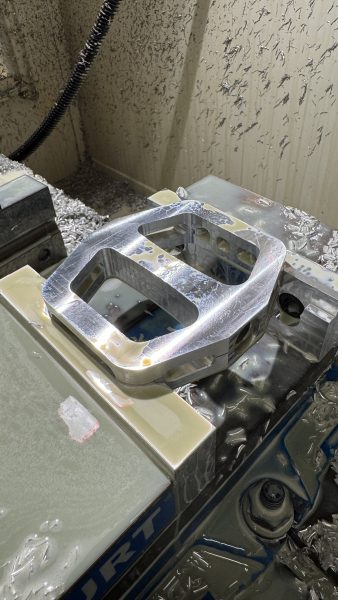
In practice, a set of soft jaws begins as a blank mounted to the master jaws of the chuck. The machinist then bores, mills, or contours the gripping surface to conform to the workpiece. Because this operation is performed in the same setup as the final machining, the resulting grip is inherently concentric (or otherwise aligned) with the machine’s spindle axis. This makes soft jaws especially valuable for precision turning operations where repeatability and minimal runout are required.
Functional Principle
The key idea behind soft jaws is that the workholding surface is created under controlled conditions that mirror the final machining environment. When the jaws are bored to a specific diameter under clamping load, they “spring” into their natural clamping position when released. When a part is then inserted and clamped, the contact geometry matches the bored condition, producing uniform contact around the circumference.
This approach addresses a common limitation of hard jaws. Even when hard jaws are ground, wear and slight misalignment can introduce runout. Soft jaws eliminate this by making the gripping surface specific to the part and the current machine condition.
Machining the Jaw Profile
The preparation of soft jaws is often referred to as “boring the jaws,” although the process may involve turning, facing, or even milling depending on the required geometry. A ring, plug, or step is typically used to preload the jaws during machining so that they are cut under realistic clamping conditions. Without this preload, the jaws would deflect during actual use, leading to poor contact and loss of accuracy.
The geometry produced in the jaws can take several forms. A simple cylindrical bore is common for round parts, but stepped diameters are frequently used to locate the part axially as well as radially. For non-cylindrical parts, the jaws may be contoured to match flats, irregular profiles, or cast surfaces. In milling applications, soft jaws mounted in a vise can be machined with pockets that nest the workpiece, providing both location and clamping support.
Materials and Wear Considerations
Soft jaws are typically made from mild steel, though aluminum jaws are also common, particularly when part marking must be minimized. The tradeoff is durability. Because the jaws are intentionally soft, they wear and deform over time, especially in high-volume production or when machining abrasive materials.
However, this limited lifespan is part of their intended use. Soft jaws are considered semi-consumable tooling. When worn or when a new part geometry is introduced, they are simply re-machined or replaced. In many shops, it is common to maintain multiple sets of jaws for different part families.
Accuracy and Repeatability
One of the primary advantages of soft jaws is their ability to provide high repeatability. Once machined, the jaws will locate parts consistently as long as they are reinstalled in the same orientation on the chuck. Most jaw systems are numbered or otherwise indexed to ensure proper positioning.
Soft jaws also allow for minimal distortion of the workpiece. Because the contact area can be increased and shaped to match the part, clamping forces can be distributed more evenly. This is particularly important for thin-walled components, where point contact from hard jaws could cause deformation.
Applications
Soft jaws are widely used in production turning, especially for parts that require secondary operations or tight concentricity between features. They are also common in milling, where machinists modify vise jaws to hold complex geometries or to support multiple parts in a single setup.
In many cases, soft jaws serve as a bridge between general-purpose workholding and dedicated fixtures. They offer much of the precision and repeatability of a custom fixture, but with significantly lower cost and setup time.
Limitations
Despite their advantages, soft jaws are not universally appropriate. They require setup time to machine, which may not be justified for one-off parts. They also depend on proper technique—incorrect preload, poor machining practices, or failure to maintain jaw orientation can negate their benefits.
Additionally, because they are softer than the workpiece in many cases, they are more susceptible to damage from chips, burrs, or improper handling. Cleanliness and inspection become important aspects of their use.