
Bonus tolerance (in position control) is a concept within geometric dimensioning and tolerancing (GD&T) that applies when a feature of size is controlled at a material condition modifier, most commonly Maximum Material Condition (MMC). It provides a practical and functionally meaningful way to allow additional positional variation as a feature departs from its most restrictive size.
For a hole, MMC corresponds to the smallest allowable diameter, since that condition contains the most material. When a positional tolerance is specified at MMC, the stated tolerance applies when the hole is at this smallest size. If the hole is produced larger than MMC, the difference between the actual size and the MMC size becomes bonus tolerance, which increases the allowable positional variation.
In simple terms, bonus tolerance can be expressed as:
bonus tolerance = actual size − MMC size
The total allowable positional tolerance is then:
total positional tolerance = stated positional tolerance + bonus tolerance
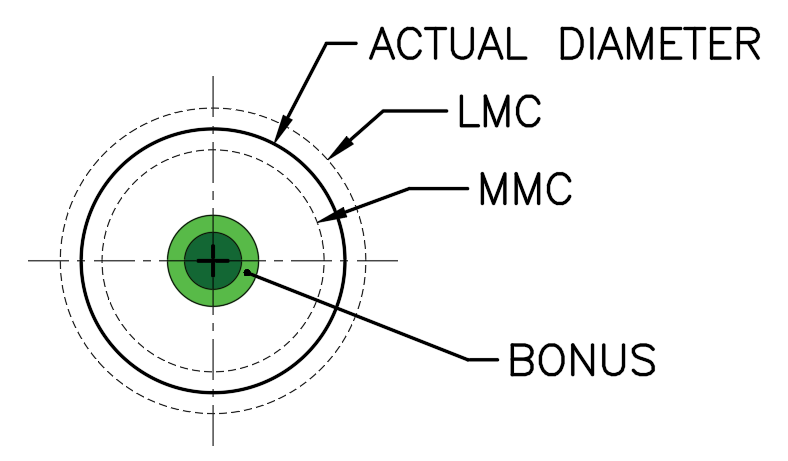
This relationship reflects an important functional idea. When a hole becomes larger, it can tolerate more positional error and still accommodate a mating feature, such as a pin. Conversely, when the hole is at its smallest size (MMC), positional accuracy must be at its highest.
A related concept is the virtual condition, which represents the worst-case boundary for functional assembly. For a hole with a positional tolerance at MMC, the virtual condition is a fixed value derived from the MMC size and the geometric tolerance. This boundary is often interpreted physically as the size of a functional gage pin used to verify that the feature will assemble properly under worst-case conditions.
Bonus tolerance is widely used in engineering design because it allows designers to specify functional requirements without being overly restrictive. It provides additional manufacturing flexibility while maintaining assembly integrity. In practice, it rewards processes that produce features away from the worst-case material condition by permitting greater positional variation without compromising function.
Understanding bonus tolerance requires recognizing the distinction between size variation and geometric variation, and how they interact. Rather than treating these as independent limits, GD&T links them in a way that reflects real-world assembly behavior.