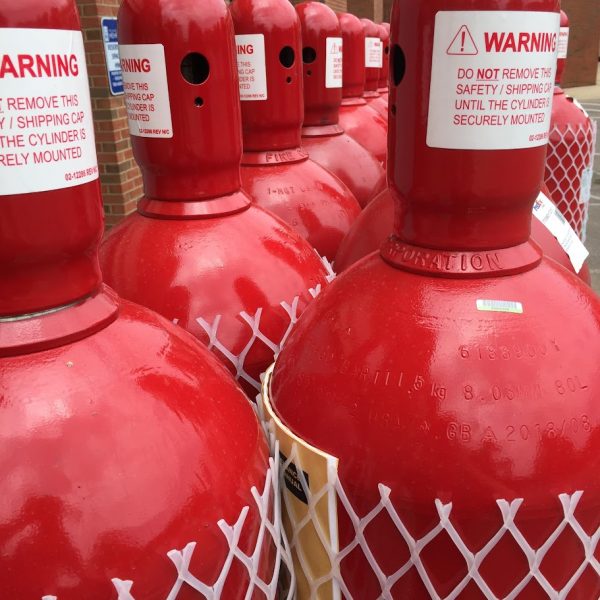
Gas quenching is a heat-treatment process in which heated metal parts are cooled using circulating gases rather than liquid quench media. The process is most commonly associated with vacuum furnaces, where gases such as nitrogen, argon, or helium are introduced under controlled pressure to cool the workpiece after heating. Gas quenching provides relatively clean and uniform cooling and is widely used for precision components and high-alloy steels.
In a typical gas-quenching process, the workpiece is first heated inside a vacuum or controlled-atmosphere furnace. After the austenitizing stage is complete, the furnace chamber is filled with a quenching gas that circulates rapidly around the parts. Fans, blowers, or gas nozzles increase heat transfer by forcing the gas across the surfaces of the workpiece.
Compared to liquid quench media such as water or oil, gases generally cool more slowly. For this reason, gas quenching is most often used with steels that have high hardenability, including many air-hardening and vacuum-hardening tool steels. Some stainless steels and aerospace alloys are also commonly processed using gas quenching.
One advantage of gas quenching is reduced distortion. Because gases cool more uniformly and avoid the thermal shock associated with liquid immersion, internal stresses are often lower. This is especially important for precision tools, dies, bearings, gears, molds, and aerospace components where dimensional stability is critical.
Gas quenching is also valued for surface cleanliness. Since the process often occurs in a vacuum or low-oxygen environment, oxidation, scaling, and decarburization are greatly reduced. Parts may emerge from the furnace with bright, clean surfaces that require little post-processing.
Several gases are used in industrial quenching systems. Nitrogen is common because it is relatively inexpensive and inert under many conditions. Argon may be used where greater chemical inertness is required. Helium has very high thermal conductivity and can provide faster cooling rates, although it is considerably more expensive.
Cooling performance depends on gas type, pressure, circulation speed, and part geometry. Modern vacuum furnaces may use high-pressure gas quenching systems operating at several bar of pressure to increase heat extraction. High-pressure nitrogen or helium systems can produce cooling rates sufficient for many high-alloy steels.
Gas quenching systems are often integrated directly into vacuum furnaces. In these systems, the same chamber used for heating is also used for cooling, reducing handling and contamination. Heat-treatment cycles can therefore be highly controlled and repeatable.
Although gas quenching reduces many problems associated with liquid quenching, it is not suitable for every alloy. Steels with low hardenability may not cool rapidly enough in gas to form martensite throughout the section thickness. For these steels, oil or water quenching may still be required.
Gas quenching equipment is also more complex and expensive than traditional liquid quench systems. Vacuum furnaces, pressure vessels, circulation systems, and gas recovery systems represent a significant industrial investment. However, the improved cleanliness, dimensional stability, and process control make gas quenching an important technology in modern heat treatment.