Quench media are substances used to cool a heated metal during heat treatment. In steels, quenching is commonly performed after the material has been heated into the austenitizing range. The rate at which the metal cools can strongly influence hardness, strength, toughness, residual stress, and distortion. Because different alloys require different cooling rates to achieve their desired properties, the selection of quench media is an important part of heat-treatment practice.
The primary function of a quench medium is to control how quickly heat is removed from the workpiece. Faster cooling generally increases hardness in steels by promoting the formation of martensite, while slower cooling may produce softer or tougher microstructures. Excessively rapid cooling can also increase the likelihood of cracking, warping, or residual stresses. A quench medium must therefore balance cooling performance with dimensional stability and the characteristics of the alloy being treated.
Several factors influence quench severity. These include the temperature of the quench medium, the motion or agitation of the fluid, the geometry and thickness of the part, and the thermal properties of the medium itself. Some media remove heat rapidly during the early stages of cooling but more slowly later in the process. Others provide a more gradual and uniform cooling curve.
Water is one of the oldest and most aggressive quench media. It removes heat rapidly and is often used for plain carbon steels that require fast cooling rates. However, water quenching can increase distortion and cracking, especially in complex or highly hardened parts. Saltwater brines are even more severe because dissolved salts reduce the insulating vapor layer that forms around hot metal during quenching.
Oil is a widely used quench medium because it cools more slowly and uniformly than water. Many alloy steels are designed specifically for oil quenching. Oils can reduce the risk of cracking and distortion while still providing sufficient cooling to achieve hardness. Different oils are formulated for different cooling rates, flash points, and operating temperatures.
Some steels are designed to harden with relatively slow cooling rates and may be air quenched. In these cases, the workpiece is removed from the furnace and allowed to cool in still air, forced air, or under controlled atmospheric conditions. Air-hardening tool steels are common examples. Because the cooling rate is slower and more uniform, air quenching can reduce distortion in precision parts.
Gas quenching is commonly used in vacuum furnaces. Nitrogen, argon, helium, or other gases may be circulated at high pressure to cool the workpiece. Gas quenching is often associated with vacuum heat treatment because it helps maintain clean surfaces and reduces oxidation and decarburization.
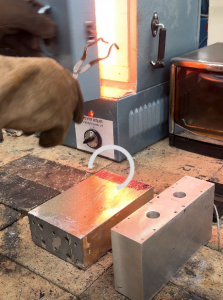
Plate quenching is frequently used for thin, flat components such as knives or precision plates. In this method, the heated part is clamped between large metal plates, often aluminum, which rapidly conduct heat away from the workpiece. Air may also be forced between the plates to increase cooling. Plate quenching can reduce warping compared to free-air cooling.
Polymer quenchants are water-based solutions that provide cooling characteristics between water and oil. By adjusting the concentration of the polymer, the cooling rate can be modified for different applications. These quenchants are common in industrial heat-treatment systems where repeatability and fire safety are important concerns.
Molten salt baths may also be used as quench media. These can provide highly controlled cooling rates and are often used in specialized processes such as martempering or austempering. Salt baths can reduce thermal shock and improve dimensional stability compared to more severe quenching methods.
The selection of a quench medium depends on the alloy composition, section thickness, desired mechanical properties, distortion tolerance, surface requirements, and available equipment. Heat-treatment data provided by steel manufacturers commonly specifies suitable quenching methods for particular grades of steel.