
Tempering is a heat treatment process used to reduce brittleness and internal stresses in hardened steel while improving toughness and stability. It is commonly performed after quenching, particularly when steel has been hardened to form martensite. Although quenched steel can achieve very high hardness, it is often too brittle for practical use unless tempered.
In a typical tempering process, the hardened steel is reheated to a temperature below its lower critical temperature and held for a period of time before cooling. Tempering temperatures commonly range from approximately 150 °C to over 650 °C depending on the steel and the desired mechanical properties. Lower tempering temperatures generally preserve more hardness, while higher temperatures increase toughness and ductility.
During quenching, rapid cooling can trap carbon atoms within the iron crystal structure, producing hard but highly stressed martensite. Tempering allows some of these internal stresses to relax and promotes the formation of more stable microstructures. As tempering temperature and time increase, hardness generally decreases while toughness and impact resistance improve.
The relationship between hardness and toughness is an important consideration in heat treatment. Cutting tools, knives, and wear-resistant components are often tempered at relatively low temperatures to maintain hardness. Springs, shafts, structural components, and impact-resistant tools are commonly tempered at higher temperatures to achieve greater toughness and resistance to cracking.
One visible effect of tempering is the formation of oxide colors on polished steel surfaces when heated in air. These tempering colors are produced by thin oxide films that form on the steel surface. The observed color depends primarily on oxide thickness, which increases with temperature and time. Historically, blacksmiths and toolmakers often used these colors as a rough visual indication of temperature during manual heat treatment.
Common tempering colors include:
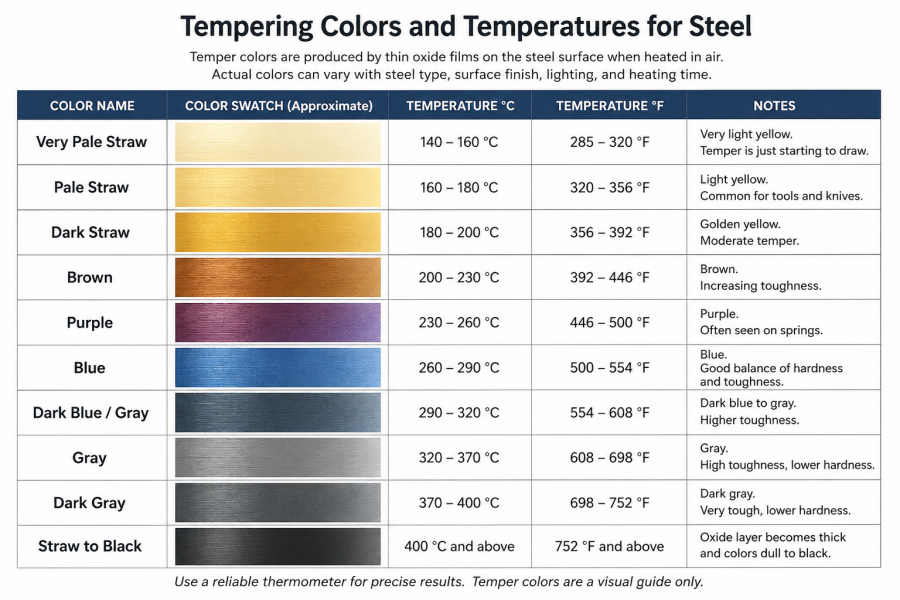
Although temper colors can provide a useful visual reference, they are not a precise substitute for controlled temperature measurement. Surface condition, lighting, alloy composition, and heating atmosphere can all influence the appearance of the oxide films.
Some steels may also undergo multiple tempering cycles. Double tempering and triple tempering are common with certain alloy and tool steels because retained austenite and complex carbide transformations can require repeated thermal cycling for optimal properties.
Tempering is one of the most important operations in steel heat treatment because it allows the mechanical properties of steel to be adjusted for specific applications. By balancing hardness, strength, toughness, and ductility, tempering transforms brittle quenched steel into a material suitable for practical engineering use.