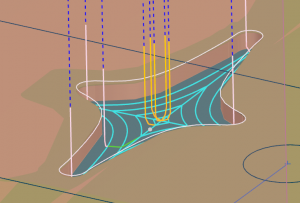
Fixed-axis surface contouring operations are CNC machining strategies used to machine three-dimensional surfaces while maintaining a constant tool axis orientation. Unlike multi-axis machining operations, which continuously tilt and rotate the cutting tool, fixed-axis operations keep the tool aligned along a single axis, typically the spindle axis of a three-axis machining center.
These operations are commonly used to finish sculpted surfaces, molds, dies, engravings, and other parts containing complex geometry accessible via a single tool orientation. Toolpaths are generated from the shape of selected surfaces, allowing the cutting tool to follow contours, curves, and transitions within the model. Ball end mills are frequently used because they can accurately reproduce curved surfaces and fine details.
Several fixed-axis contouring strategies are available, each optimized for particular surface conditions. Some operations follow constant Z levels on steep walls, while others generate offset passes across broad surface regions or follow the natural flow of the model’s geometry. The choice of operation affects machining time, surface finish, scallop height, and tool motion efficiency.
Although modern CAM systems provide a variety of surface-machining strategies, they share the common goal of producing accurate freeform geometry using a cutting tool whose axis remains fixed throughout the operation.
- Fixed-Axis Guiding Curves
- Contour Area
- Contour Surface Area
- Streamline
- Flowcut Single
- Flowcut Multiple
- Flowcut Reference Tool
- Contour Text