
Accuracy and precision are two of the most important concepts in measurement. Although the terms are often used interchangeably in everyday conversation, they have distinct meanings in science, engineering, and metrology.
A measurement is considered accurate when it is close to the true or accepted value. A measurement is considered precise when repeated measurements produce similar results.
In simple terms, accuracy describes how close a measurement is to the correct value, while precision describes how consistently measurements agree with one another.
Accuracy
Accuracy refers to the closeness of a measurement to the true value of the quantity being measured.
Suppose a shaft has a true diameter of 25.00 mm. A measured value of 25.01 mm would be considered highly accurate because it is very close to the actual diameter. A measurement of 24.50 mm would be much less accurate because it differs significantly from the true value.
Accurate measurements are important because they help ensure that reported values correctly represent the physical quantity being measured.
Precision
Precision refers to the agreement among repeated measurements.
Suppose a part is measured several times and produces the following results:
25.51 mm
25.50 mm
25.52 mm
25.51 mm
These measurements are very close to one another and therefore exhibit good precision.
However, if the true diameter of the part is 25.00 mm, the measurements are not accurate despite being highly precise.
Precision is often associated with consistency and repeatability.
Accuracy and Precision Together
Accuracy and precision are independent characteristics. A measurement system may be accurate but not precise, precise but not accurate, both accurate and precise, or neither.
A common illustration uses a target:
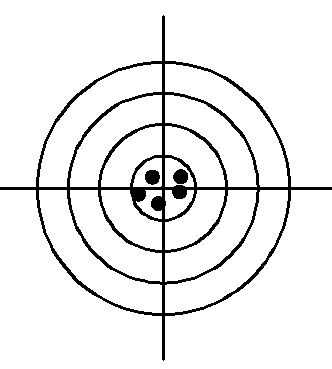
Accurate and Precise: The shots are tightly grouped near the center of the target.
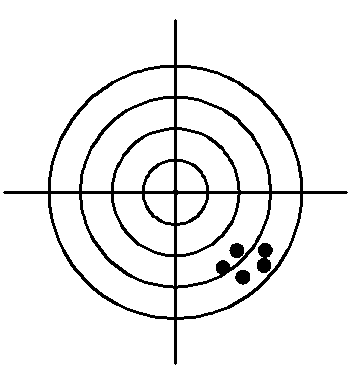
Precise but Not Accurate: The shots are tightly grouped but located away from the center.
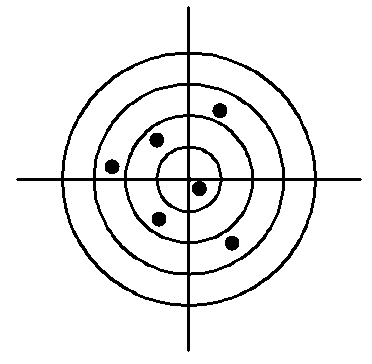
Accurate but Not Precise: The shots are widely scattered around the center. The average position is near the center, but individual shots vary considerably.
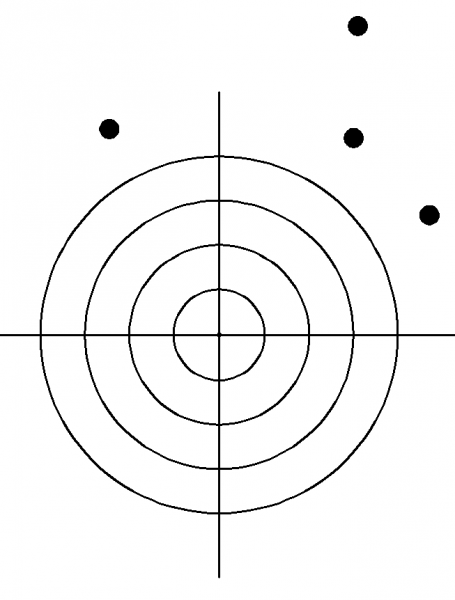
Neither Accurate nor Precise: The shots are widely scattered and far from the center.
The center of the target represents the true value, while the individual shots represent measurement results.
Sources of Poor Accuracy
Poor accuracy is often caused by systematic errors, including:
- Improper calibration
- Instrument bias
- Worn measuring equipment
- Environmental influences
- Incorrect measurement procedures
These factors can cause measurements to be consistently higher or lower than the true value.
Sources of Poor Precision
Poor precision is often caused by random variations, including:
- Operator technique
- Instrument resolution limits
- Environmental fluctuations
- Variations in the measurement process
These factors cause measurements to vary from one reading to the next.
In engineering and manufacturing, both accuracy and precision are important.
A measuring instrument that produces highly repeatable results but consistently reports incorrect values can lead to defective parts being accepted. Likewise, an instrument that is accurate on average but produces widely varying readings may not provide enough confidence for quality control decisions.
Effective measurement systems strive to achieve both accuracy and precision so that measurements are both correct and repeatable.