Softening methods are heat-treatment processes used to reduce hardness, improve ductility, relieve internal stresses, or improve machinability in steels and other ferrous alloys. These processes are commonly performed after forging, welding, machining, casting, cold working, or hardening operations. In manufacturing, softening treatments are often used to prepare steel for further processing or to improve the stability and performance of finished components.
Unlike hardening operations, which are intended to increase strength and wear resistance, softening processes generally make steel easier to machine, bend, form, or otherwise work. Some softening methods are also used to restore ductility that has been lost during cold working or prior heat treatment.
Many softening processes involve heating the steel to a controlled temperature followed by a controlled cooling cycle. The heating and cooling rates, holding time, and peak temperature all influence the resulting microstructure and mechanical properties. Depending on the process, heat treatment may alter the distribution of ferrite, pearlite, cementite, carbides, or martensite within the steel.
Annealing is one of the most widely used softening methods. In a typical annealing process, steel is heated and then cooled slowly, often within the furnace itself. This slow cooling produces a softer and more stable microstructure while reducing internal stresses. Annealing is commonly used to improve machinability and restore ductility.
Normalizing is similar to annealing but usually involves cooling the steel in still air rather than furnace cooling. Compared to full annealing, normalizing often produces a finer grain structure and somewhat higher strength while still relieving many stresses created during hot working or casting.
Stress relieving is used primarily to reduce residual stresses without significantly changing the hardness or overall microstructure of the steel. Welding, machining, uneven cooling, and forming operations can introduce internal stresses that may later cause distortion or cracking. Stress-relief heat treatment helps reduce these effects.
Spheroidizing is a specialized softening treatment commonly applied to high-carbon steels and tool steels. During this process, carbide structures become more rounded or spheroidal in shape. This condition greatly improves machinability and formability in steels that would otherwise be difficult to machine.
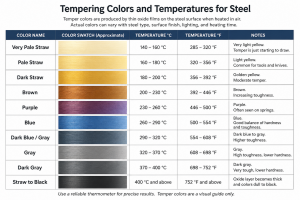
Tempering may also function as a softening process. After quenching, hardened steel is often extremely hard and brittle due to the formation of martensite. Tempering reheats the steel to a lower temperature to reduce brittleness, relieve stresses, and improve toughness while retaining part of the hardness.
Process annealing is commonly used for low-carbon steels that have been heavily cold worked. Rolling, bending, stamping, or drawing operations can harden steel through strain hardening. Process annealing restores ductility so the material can undergo additional forming operations.
The selection of a softening method depends on the composition of the steel, the desired mechanical properties, the manufacturing process, and the intended application of the part. Different steels may respond very differently to the same heat-treatment cycle.
Surface oxidation and scale formation are often concerns during heat treatment. When steel is heated in air, oxidation and decarburization may occur at the surface. Controlled atmosphere furnaces, vacuum furnaces, stainless foil wrapping, or anti-scale compounds may be used to reduce these effects.
Softening methods are an important part of steel manufacturing and heat treatment. They are widely used to improve machinability, restore ductility, relieve stress, refine grain structure, and prepare steel for additional processing or service.