
The Lockheed SR-71 Blackbird is one of the best-known examples of titanium use in aircraft construction. Approximately 93 percent of the aircraft’s structural weight consisted of titanium alloys.[1] Titanium offered high strength at substantially lower density than steel while retaining useful properties at the elevated temperatures produced by sustained flight above Mach 3.
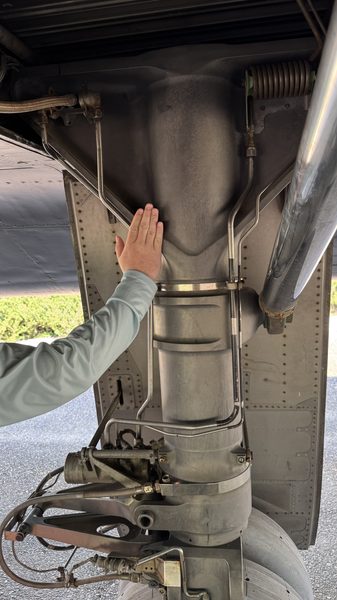
One particularly interesting application was the SR-71’s landing gear. Both the main and nose landing gear made extensive use of the high-strength beta titanium alloy Ti-13V-11Cr-3Al. The main landing gear included an exceptionally large titanium forging, described in historical accounts as the largest titanium forging produced in the United States at the time.[2]
The component provides an excellent example of both the advantages of titanium alloys and the manufacturing challenges associated with these materials during the early development of the titanium industry.
Ti-13V-11Cr-3Al
The alloy used extensively in the SR-71 landing gear was Ti-13V-11Cr-3Al, commonly abbreviated Ti-13-11-3 and also known as B120VCA or VCA120. Its nominal composition is 13 percent vanadium, 11 percent chromium, 3 percent aluminum, with the balance titanium.
Ti-13-11-3 is a metastable beta titanium alloy. Unlike commercially pure titanium or the familiar alpha-beta alloy Ti-6Al-4V, beta titanium alloys contain sufficient beta-stabilizing elements to retain a metastable beta structure after appropriate processing. They can then be solution treated and aged to develop very high strength.
Ti-13-11-3 became one of the earliest important beta titanium alloys. A review of beta titanium development describes it as the “backbone alloy” of the SR-71 and identifies the aircraft’s landing gear, wing beams, fuselage bulkheads, frames, and skin among its applications.[3] Another technical account specifically identifies forgings for the “complete main and nose landing gears.”[4]
For landing gear, the alloy provided an especially useful combination of high strength and relatively low density. Landing-gear components experience large concentrated loads during landing, braking, and ground operations. Titanium allowed these requirements to be met without the weight associated with an equivalent high-strength steel structure.
An Enormous Titanium Forging
The size of the main landing-gear forging made its manufacture particularly significant.
A Smithsonian Air & Space account describes the Blackbird landing gear as the “largest titanium forging produced in the United States” at the time.[5] Former SR-71 pilot Lt. Col. Ed Carpenter similarly described it as the “largest Titanium forging ever tried.”[6]
These descriptions should be understood in their historical context. They refer to the state of titanium manufacturing during Blackbird development in the late 1950s and early 1960s, rather than to an enduring record. Later aircraft employed still larger titanium forgings.
Nevertheless, producing a forging of this size from a high-strength titanium alloy was a remarkable manufacturing achievement for the period.
From Forging to Finished Component
The rough forging was considerably larger than the finished landing-gear component.
Titanium was still a relatively new structural material, and the aerospace industry had limited ability to produce large titanium forgings close to their final dimensions. As a result, some Blackbird forgings began with far more material than the finished component required.
Kelly Johnson, head of Lockheed’s Skunk Works, reported that approximately 90 percent of the material in some rough forgings, including landing-gear components, had to be machined away.[7] NASA’s history of Blackbird development describes the same problem, noting that large titanium components sometimes required removal of approximately 90 percent of their original forging weight.[1]
This created an enormous manufacturing challenge. Titanium is expensive and difficult to machine. Its relatively low thermal conductivity concentrates heat near the cutting tool, while the material retains considerable strength at elevated temperatures. Tool wear can therefore be severe.
According to NASA, Lockheed initially achieved a metal-removal rate in high-strength titanium of only about five percent of that obtainable in aluminum. The company developed new drills, cutting equipment, profiler powerheads, and cutting lubricants specifically to improve titanium machining.[1]
The landing gear therefore illustrates an important manufacturing principle: selecting a material cannot be separated from determining how that material will actually be made into a component.
Inspection and Material Control
Large titanium forgings also required unusually careful quality control.
Johnson reported that Lockheed removed twelve test coupons from large forgings such as landing-gear components before machining.[7] This allowed the material to be evaluated before committing substantial time and expense to producing the finished part.
The Blackbird program developed an extensive material-control system in which titanium components could be traced to individual material heats. Such procedures helped establish practices that became increasingly important as titanium entered wider aerospace use.
A Manufacturing Milestone
Ti-13-11-3 was not without problems. Its high chromium content could cause segregation during melting, and obtaining consistent combinations of strength and toughness was difficult.[8] Later beta titanium alloys offered improved processing characteristics and eventually replaced it in many aerospace applications.
Nevertheless, its use on the SR-71 was remarkably successful. The Blackbird pushed titanium technology beyond relatively small or specialized applications and into enormous, highly loaded structural components.
The SR-71 landing gear is therefore an especially useful example of engineering material selection. Titanium was not chosen simply because it was lightweight or technologically exotic. The alloy provided the high strength required for landing gear while reducing weight compared with an equivalent steel structure.
At the same time, producing the component required advances in forging, heat treatment, machining, inspection, and process control. The landing gear demonstrates that the properties of an engineering material are only part of the story. A successful material must also be transformed into a reliable component—and in the case of the SR-71, learning how to do that was itself a major engineering achievement.
Footnotes
[1] Peter W. Merlin, “Design and Development of the Blackbird: Challenges and Lessons Learned,” NASA Dryden Flight Research Center, presented at the 47th AIAA Aerospace Sciences Meeting, 2009. Merlin reports that 93 percent of the Blackbird’s structural weight consisted of titanium alloys and discusses the extensive machining and manufacturing-process development required for the aircraft. https://ntrs.nasa.gov/api/citations/20090007797/downloads/20090007797.pdf
[2] The description of the main landing gear as an exceptionally large titanium forging appears in several accounts. See Preston Lerner, “The Real X-Jet,” Air & Space Magazine, Smithsonian Institution. https://www.smithsonianmag.com/air-space-magazine/the-real-x-jet-12377380/
[3] Zhu Zhang, Songxiao Hui, Wenjun Ye, and Shuqi Zhang, “Development of Beta Titanium Alloys,” in Titanium ’99: Science and Technology. The authors identify Ti-13V-11Cr-3Al (B120VCA) as a metastable beta titanium alloy and describe it as a backbone alloy for the SR-71. https://cdn.ymaws.com/titanium.org/resource/resmgr/ZZ-WTCP1999-VOL1/1999_Vol.1-4-Development_of_.pdf
[4] “Development of Beta Titanium Alloys,” Titanium ’99: Science and Technology. The discussion of the SR-71 identifies applications of Ti-13V-11Cr-3Al including forgings for the complete main and nose landing gear. https://cdn.ymaws.com/titanium.org/resource/resmgr/ZZ-WTCP1999-VOL1/1999_Vol.1-4-Development_of_.pdf
[5] Preston Lerner, “The Real X-Jet,” Air & Space Magazine, Smithsonian Institution. The article describes the Blackbird landing gear as the largest titanium forging produced in the United States at the time. https://www.smithsonianmag.com/air-space-magazine/the-real-x-jet-12377380/
[6] Lt. Col. Ed Carpenter, USAF (Ret.), “SR-71 Overview,” technical presentation. Carpenter, a former SR-71 pilot, describes the landing gear as the “largest Titanium forging ever tried.” https://roadrunnersinternationale.com/carpenter/uhc_sr-71_mstr_trn_c-Jun10.pdf
[7] Clarence L. “Kelly” Johnson, “Developing the SR-71,” Lockheed Advanced Development Projects. Johnson discusses titanium manufacturing for the Blackbird, including material testing of large landing-gear forgings and the extensive machining required to produce finished components.
[8] R. R. Boyer, “Opportunities and Issues in the Application of Titanium Alloys for Aerospace Components,” Metals, Vol. 10, No. 6, 2020, Article 705. https://www.mdpi.com/2075-4701/10/6/705